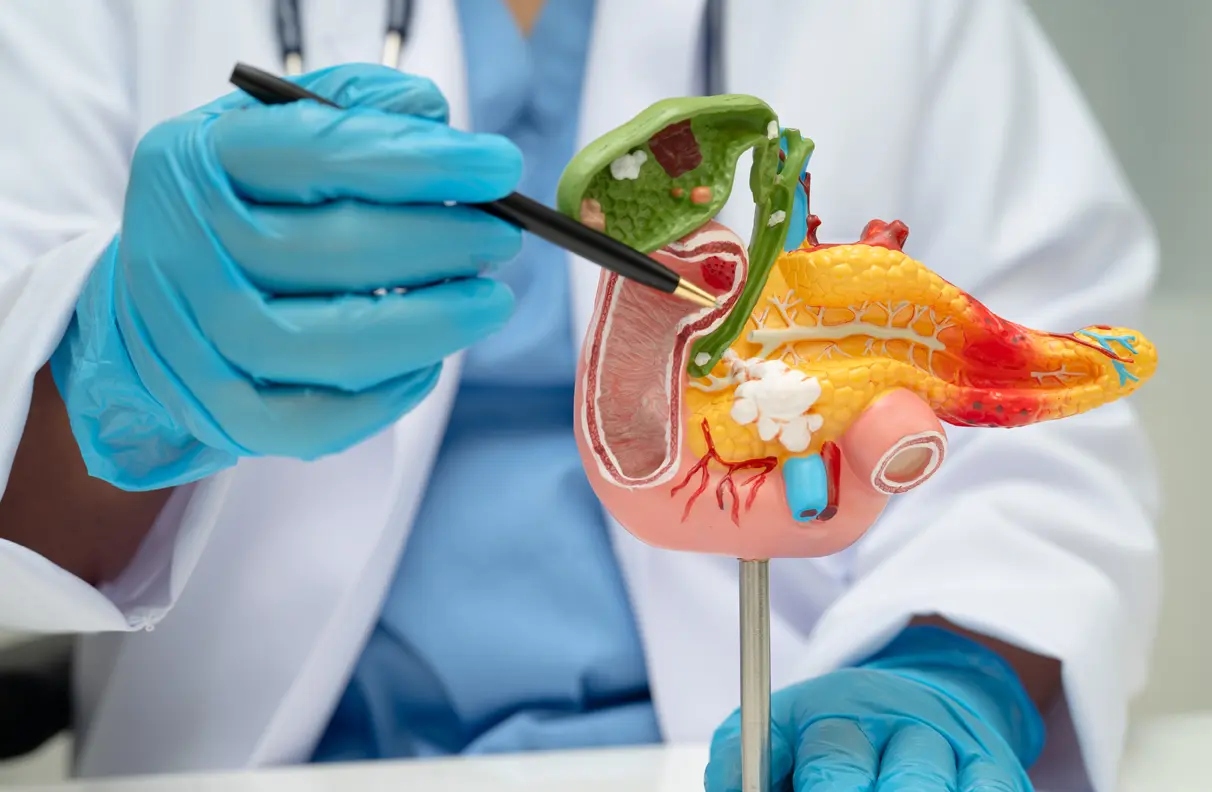
What Is Laparoscopic Pancreatectomy?
Commonly referred to as keyhole surgery, laparoscopic pancreatectomy involves accessing the abdomen through
several small incisions, usually measuring between 5–12 mm. A laparoscope, which is a thin instrument fitted
with a small camera, allows the surgeon to view the internal anatomy on a monitor in magnified detail.
Specialised instruments are then introduced through the incisions to carry out the procedure.
This minimally invasive technique is widely used for pancreatic resections, offering several advantages over
the traditional open procedure:
- Reduced Trauma and Pain: Smaller incisions result in significantly less operative trauma and, consequently, reduced post-operative pain and discomfort.
- Faster Recovery: Patients typically experience accelerated functional recovery, enabling them to mobilise sooner and regain normal appetite faster.
- Shorter Hospital Stays: The reduced physiological stress leads to shorter required periods in the hospital.
- Lower Blood Loss: Precision surgery often translates to reduced intraoperative blood loss.
- Improved Cosmetic Outcomes: The smaller wounds leave less prominent scarring.
A common variant is the removal of the body and tail of the pancreas, known as laparoscopic
distal pancreatectomy. This procedure is generally less complex than a Whipple procedure,
making it an ideal entry point for minimal access techniques in pancreatic surgery.
Who Is a Good Candidate for Laparoscopic Pancreatectomy?
Careful patient selection is essential to achieving favourable outcomes with laparoscopic
techniques. Suitability depends on specific clinical criteria, including the characteristics of
the disease and the patient’s overall health status.
Disease Characteristics
Patients considered suitable for laparoscopic pancreatic surgery typically have specific
disease features that allow the procedure to be performed safely and effectively.
- Benign or Low-Grade Malignant Lesions: These include many non-invasive
cystic lesions,
such as selected intraductal papillary mucinous neoplasms or mucinous cystic neoplasms,
as well as neuroendocrine tumours located in the body or tail of the pancreas.
- Localised Disease: The tumour should be confined to the pancreas, with
no evidence of spread to distant organs or significant involvement of major blood
vessels, such as the portal vein or superior mesenteric artery.
- Favourable Tumour Location: Lesions in the body or tail of the pancreas
are generally more suitable for a laparoscopic approach. Tumours in the head of the
pancreas often require a more complex open procedure, such as a pancreaticoduodenectomy.
Patient Health and Fitness
In addition to tumour-related factors, a patient’s overall physical condition plays an
important role in determining suitability for laparoscopic pancreatic surgery.
- Overall Health: Patients must be fit to undergo general anaesthesia and
able to tolerate pneumoperitoneum, which involves inflating the abdomen with carbon
dioxide during laparoscopy. Performance status and the absence of significant cardiac or
respiratory conditions are key considerations.
- Absence of Extensive Scar Tissue: Extensive scar tissue, known as
adhesions, from prior abdominal operations, may complicate laparoscopic dissection.
While this does not always exclude a patient from laparoscopic surgery, it can increase
operative difficulty and, in some cases, require conversion to an open procedure.
Factors That May Affect Eligibility
In certain clinical situations, a minimally invasive approach may not be suitable or even carry increased risk. In
such cases, the surgical team may recommend a traditional open operation instead.
Tumour Size and Complexity
Very large tumours or those exhibiting local inflammation, which obscures the surgical plane, may require the
superior tactile feedback and direct exposure provided by open surgery.
Vascular Invasion
If imaging confirms significant encasement or direct invasion of key surrounding blood vessels, the procedure
requires intricate and time-consuming vascular reconstruction. This high-risk scenario is often best managed with an
open approach, unless the surgeon is highly experienced in complex robotic or hand-assisted laparoscopy.
Advanced Disease Spread
Patients with advanced pancreatic cancer,
including metastatic spread to the liver,
peritoneum or distant lymph nodes, are typically ineligible for curative surgery, regardless
of the technique. In these cases, treatment focuses on palliative care.
Existing Comorbidities
Severe pre-existing conditions, such as uncontrolled heart disease, respiratory failure or
significant liver dysfunction, may elevate the
anaesthetic and post-operative risks beyond
an acceptable level. Patient BMI (obesity) is also a factor, as excessive visceral fat can
impede instrument manipulation and visibility.
Pre-Surgical Evaluation for Laparoscopic Pancreatectomy
The decision to proceed with a laparoscopic pancreatectomy is never taken lightly and involves a thorough
evaluation:
Initial Consultation
The patient meets a pancreatic surgeon after referral. The surgeon reviews existing imaging and reports, takes
a history, assesses fitness at a high level and explains likely options. At this stage, laparoscopy versus
open surgery is usually discussed provisionally, not definitively.
Advanced Imaging
A high-quality, pancreas-protocol CT scan is often the first step. MRI may be used to better characterise
cystic lesions or assess the pancreatic ducts and liver. Endoscopic ultrasound (EUS) may be recommended when
imaging is unclear, when tissue sampling is required or to further assess small lesions and their relationship
to nearby vessels.
Laboratory Tests
Routine blood tests help assess overall health and operative risk, including full blood count, kidney and
liver function and clotting profile. Tumour markers such as CA 19-9 may be checked in suspected pancreatic
cancer to support assessment and establish a baseline, but results are interpreted alongside imaging and
clinical findings.